

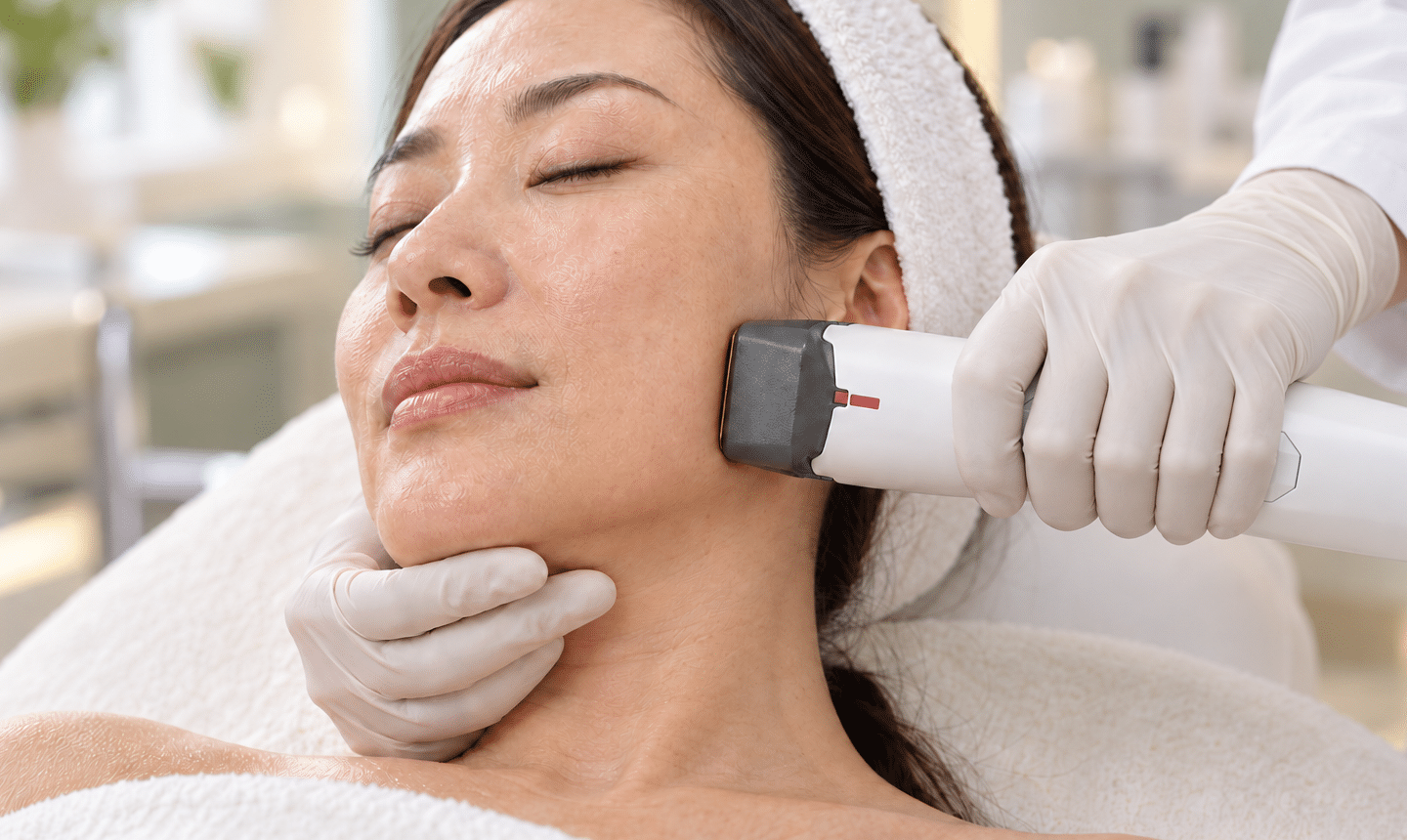
Noticing that your jawline looks softer than before, or that the skin around your lower face and neck feels less firm?
If you have been researching non-surgical skin tightening treatments, you may have come across XERF — a radiofrequency treatment that uses controlled heat to target different tissue depths.
But what exactly is XERF, and how does it differ from conventional radiofrequency treatments?
Here is a simple guide to XERF skin tightening, how monopolar RF works and what the technology is designed to do.
What Is XERF?
XERF is a non-invasive monopolar radiofrequency treatment designed to deliver controlled thermal energy into the skin and underlying tissue.
It uses two radiofrequency frequencies — 6.78 MHz and 2 MHz — together with adjustable treatment settings that allow RF energy to be delivered at different tissue depths.
The aim is to create controlled heating within collagen-containing tissue and support gradual collagen remodelling.
Unlike surgical lifting procedures, XERF does not involve incisions. It is performed externally using a treatment handpiece placed against the skin.
What Is Monopolar Radiofrequency?
To understand how XERF works, it helps to first understand monopolar radiofrequency, or monopolar RF.
Radiofrequency treatments use electrical energy to generate controlled heat within tissue.
In a monopolar RF system, energy is delivered through an electrode in the treatment handpiece. The electrical current travels through the tissue towards a separate return electrode positioned elsewhere on the body, completing the electrical circuit.
As the current moves through the tissue, electrical resistance converts part of the energy into heat.
This allows monopolar RF to create controlled heating across a broader volume of tissue.
How Does XERF Support Skin Tightening?
The main principle behind XERF is controlled tissue heating.
When radiofrequency energy passes through the tissue, electrical resistance generates heat. This thermal stimulation can affect collagen-containing structures and support biological processes involved in tissue remodelling.
Collagen is one of the main structural proteins that helps give the skin firmness and support.
As we age, changes in collagen and the deeper supporting tissues can contribute to concerns such as:
- Reduced skin firmness
- Early jowling
- A softer jawline
- Mild lower-face laxity
- Looseness around the neck
XERF uses controlled RF energy to target these tissues and support gradual changes in skin firmness and facial definition.
What Makes XERF Different?
One of the key features of XERF is its use of two radiofrequency frequencies: 6.78 MHz and 2 MHz.
Rather than relying on a single RF frequency, XERF combines these frequencies to create different heating profiles within the tissue.
The system also offers three treatment depth settings — shallow, middle and deep.
These settings allow the treatment approach to be adjusted according to the area being treated, tissue thickness and treatment goal.
This is important because the face is not uniform.
The forehead, cheeks, jawline and neck have different tissue thicknesses and anatomical characteristics, so the same treatment approach may not be appropriate for every area.
Why Does XERF Use Two RF Frequencies?
Different radiofrequency frequencies behave differently as energy travels through tissue.
XERF combines 6.78 MHz and 2 MHz RF energy, giving the doctor greater flexibility in how heat is distributed within different tissue layers.
From a patient’s perspective, the important point is not simply how “deep” a treatment can go.
Instead, the treatment can be planned according to factors such as:
- The area being treated
- Skin and tissue thickness
- Degree of skin laxity
- Facial anatomy
- Treatment goals
This allows treatment settings to be selected according to the characteristics of each area rather than applying the same approach across the entire face.
Three Depth Settings for Different Areas
XERF provides shallow, middle and deep settings, allowing the doctor to vary the treatment approach across different parts of the face and neck.
Shallow
A more superficial heating approach that may be selected for thinner treatment areas where appropriate.
Middle
Designed to provide heating across intermediate tissue levels depending on the area’s thickness and treatment goal.
Deep
Provides a deeper heating approach for areas where the anatomy and degree of laxity make this appropriate.
The goal is not to use the deepest setting everywhere.
Instead, different depth settings allow treatment to be adapted to different facial areas and tissue characteristics.
How XERF Manages Heat
Because radiofrequency skin tightening works through thermal energy, controlling heat is an important part of the technology.
XERF incorporates an Integrated Cooling Device, which provides cooling at the skin surface while radiofrequency energy is delivered.
The system also monitors the temperature at the treatment tip during energy delivery.
XERF uses a pulsed RF delivery pattern known as Wave Fit, which delivers energy through a controlled sequence according to the selected treatment setting.
Together, these features are designed to support controlled tissue heating while helping to manage the temperature at the skin surface.
Which Areas Can XERF Treat?
XERF may be considered for areas where skin laxity contributes to a softer or less defined appearance.
Depending on individual facial anatomy and assessment, treatment areas may include the:
- Cheeks
- Lower face
- Jawline
- Under-chin area
- Neck
For some people, early facial ageing does not appear as obvious sagging.
Instead, the jawline may gradually become less defined, the lower face may appear softer, or the skin around the cheeks and neck may feel less firm.
These changes can become more noticeable as collagen and the deeper supporting tissues change with age.
Who May Consider XERF Skin Tightening?
XERF may be considered for suitable individuals who are starting to notice mild to moderate skin laxity and prefer a non-invasive approach.
Concerns may include:
- Reduced skin firmness
- Early jowling
- A softer jawline
- Mild cheek laxity
- Lower-face looseness
- Loose skin around the neck
However, facial ageing does not come from skin laxity alone.
Changes in facial fat, volume, muscle activity and underlying bone structure can also affect how the face looks.
For example, a softer jawline may be related to skin laxity in one person but may be influenced more by facial volume or fat distribution in another.
This is why an assessment is important before deciding whether XERF is appropriate.
Understanding Facial Ageing Beyond Skin Laxity
When researching skin tightening treatments, it is easy to focus on how deep a device can reach or how much energy it uses.
But effective treatment planning starts with understanding which tissue is contributing to the concern.
The appearance of the face is influenced by several layers, including:
- Skin
- Collagen and connective tissue
- Facial fat
- Muscles
- Deeper structural support
Ageing can affect each of these layers differently.
This means that two people with a similar-looking jawline concern may not necessarily benefit from the same treatment.
A medical consultation allows the doctor to assess the location and degree of laxity, facial anatomy and tissue characteristics before recommending an appropriate treatment approach.
XERF Skin Tightening in Singapore at Healthsprings
At Healthsprings Laser & Aesthetic Clinic in Singapore, XERF is available as a non-invasive monopolar radiofrequency treatment for suitable patients concerned about skin laxity and changes in facial definition.
The system combines 6.78 MHz and 2 MHz radiofrequency technology with shallow, middle and deep treatment settings, allowing the treatment approach to be adjusted across different areas of the face and neck.
Treatment planning begins with a medical consultation and facial assessment.
Your doctor will assess your skin, underlying tissue, facial anatomy and areas of concern before advising whether XERF is appropriate for your treatment goals.